

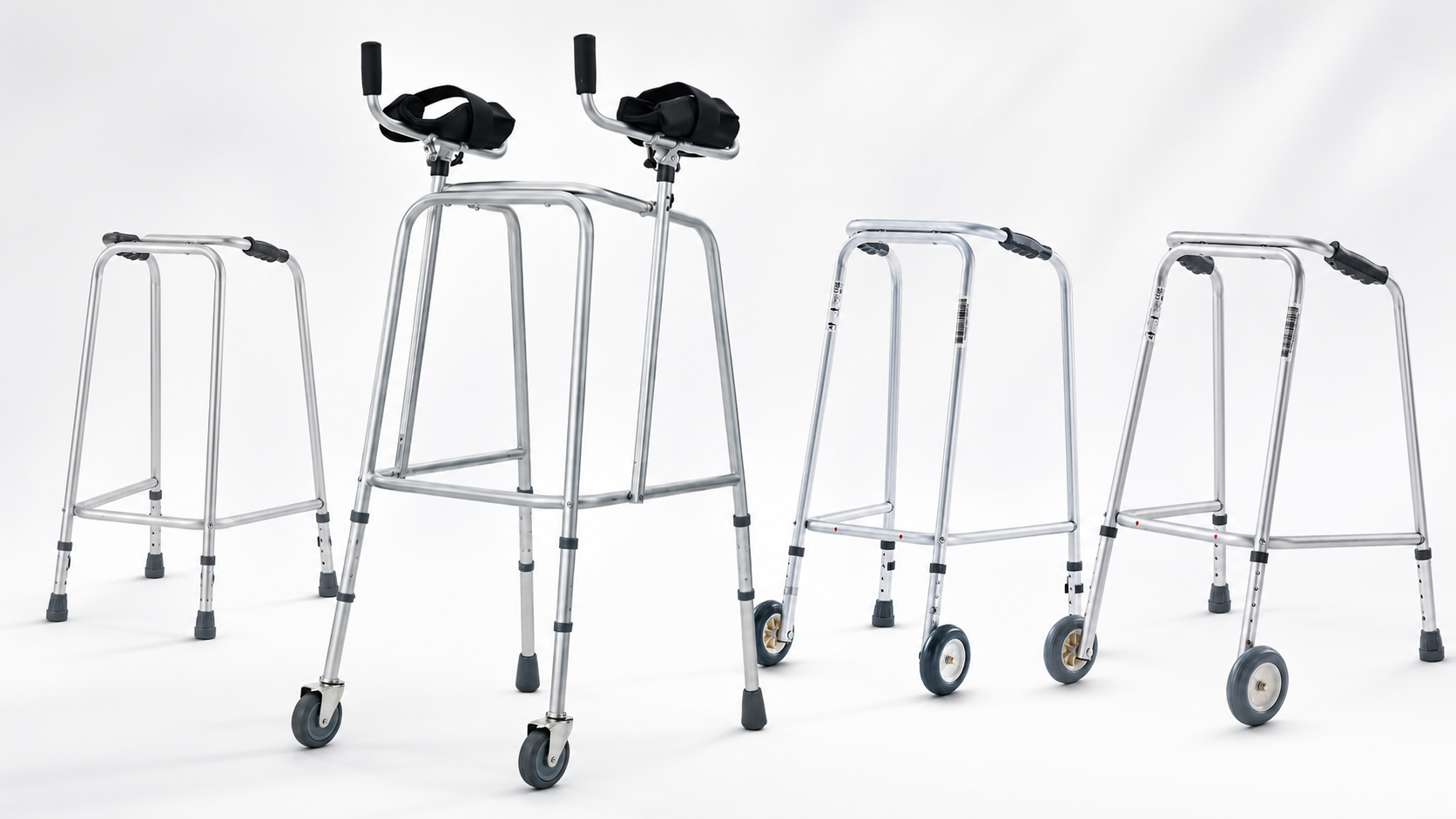
If you or someone you care for has been told a "Zimmer frame" might help, you may be wondering exactly what that means, whether it is the same as a walker or a rollator, and which type would suit you best. This guide explains what a Zimmer frame is, the different types available, how to use one safely, and how it compares to other walking aids.
Walking aids work best when they suit your individual needs and are set to the right height. If you can, ask a physiotherapist or occupational therapist to assess you — the advice below is general and not a substitute for professional guidance.
What is a Zimmer frame?
A Zimmer frame is a lightweight metal walking frame with four legs and two handles. You hold it on both sides and lean through it as you take each step, which gives you a stable, supportive base and takes the strain off tired, painful or unsteady legs. It is one of the most secure walking aids available because it supports you on both sides at once.
The name is a quirk of history: "Zimmer" is the orthopaedic company that popularised the frame and — much like "Hoover" came to mean any vacuum cleaner — "Zimmer frame" has become the everyday British term for a walking frame. You will see the two names used interchangeably.
Who is a Zimmer frame for?
A walking frame can help if you:
- are recovering from a fall, a fracture, a hip or knee operation, or a stroke;
- feel unsteady on your feet or have had a fall or near-miss;
- find a single walking stick no longer gives enough support;
- need to take weight off one or both legs while you move.
Because a frame supports you on both sides, it offers more stability than a stick or a pair of crutches — which is why it is often recommended in the early stages of recovery or for longer-term balance problems.
Types of Zimmer frame
- Standard frame (no wheels) — you lift the frame slightly and step forward into it. The most stable type, ideal indoors and for shorter distances.
- Wheeled frame — has front wheels so you push it forward rather than lifting it. Easier if your arms tire quickly or lifting is difficult.
- Ultra-narrow frame — a slimmer design for tight hallways, small bathrooms and the narrow doorways found in many older UK homes.
- Hospital frame — a sturdier, higher-capacity frame for extra support.
- Forearm (gutter) frame — padded troughs support your forearms, taking the weight through your arms rather than your hands. Ideal if wrist or hand pain, or arthritis, makes gripping difficult.
Zimmer frame vs rollator vs walker — what is the difference?
This is the question we are asked most, and the difference comes down to wheels, distance and whether you need to sit.
- A Zimmer frame (walking frame) has no seat and either no wheels or two front wheels. You move it forward and step. Best for support and stability over shorter distances, mainly indoors.
- A rollator has four wheels, hand brakes and a built-in seat. Best for longer distances and outdoor use, where you want to keep moving smoothly and have somewhere to rest.
- "Walker" is a broader word that covers both, and is also used for three-wheeled frames and wheeled frames with a seat. You can see the wheeled options in our walkers range.
As a rule of thumb: if you mainly need steadying around the house, choose a walking frame; if you are heading out and about and want a seat, choose a rollator.
How to use a Zimmer frame safely
- Set the height correctly. Standing upright with your arms relaxed, the handles should be level with the crease of your wrist, so your elbows bend only slightly when you hold on. A frame that is too high or too low is tiring and less safe.
- Move the frame a short distance forward — about an arm's length — keeping all four legs or wheels in contact with the floor.
- Step into the frame, leading with your weaker leg if you have one, then bring the other foot to meet it. Take small, even steps and stay within the frame rather than reaching ahead of it.
- Look ahead, not down at your feet, to keep your balance.
- Do not use a walking frame on stairs. Use a handrail or a stairlift, and keep the frame for level ground.
- Check the rubber feet (ferrules) regularly and replace them when the tread wears down, as worn ferrules can slip.
Can I get a Zimmer frame on the NHS?
After an assessment, an NHS physiotherapist or occupational therapist may provide a walking frame on loan. Many people also choose to buy their own — so they have one ready at home, keep a spare upstairs, or simply pick the exact type that suits them. If you are disabled or have a long-term illness, you can usually buy VAT-free.
Choosing your frame
Think about where you will use it (indoors, narrow doorways, outdoors), whether lifting a frame is comfortable or whether wheels would help, and whether you grip well or would do better with forearm supports. Our walking frames range covers all of these, and if you would like a steadier aid for outdoors with a seat, take a look at rollators. As a British manufacturer, we have been making mobility aids since 1965 — call our team on 01531 635678 or email shop@helping-hand.com if you would like help choosing.
Our walking frames
One frame for each of the types above. All are height adjustable, eligible for VAT relief, and come with free UK delivery on orders over £15.
 Domestic Walking FrameStandard — most stable, indoorsFrom £26.50View
 Domestic Frame With WheelsWheeled — push rather than liftFrom £27.25View
 Ultra-Narrow FrameNarrow — for tight doorwaysFrom £25.99View
 Hospital Walking FrameSturdier — higher capacityFrom £28.99View
 Forearm Frame with CastorsGutter — for painful handsFrom £69.99View
Not sure which is right? See the full walking frames range, or call our UK team on 01531 635678 and we will help you choose the right type and height.
If walking feels painful or unsafe, or you are unsure which aid is right, speak to your GP, physiotherapist or occupational therapist.

Share:
How to Use Crutches: Fitting, Walking, Stairs & Staying Safe
What Type of Walking Stick Do I Need?